How to organize a backyard badminton afternoon in a small space
· Editorial team houstonnewsdaily24.com
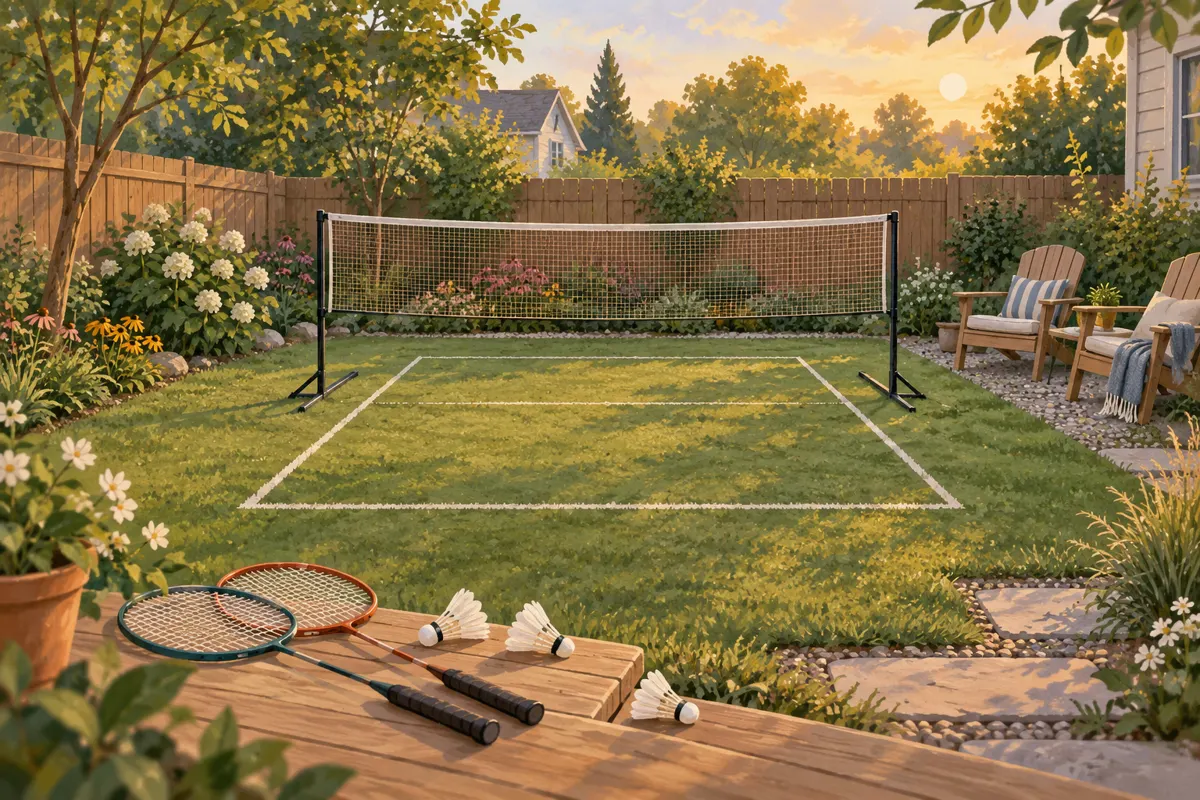
To organize badminton in a small backyard, clear a level, dry playing area, set up a portable net, and shorten the boundaries to fit the available space. Use agreed house rules and short rounds so beginners can join easily. If four players cannot move and swing comfortably, play singles and rotate guests between rounds.
Choose the playing area before setting up
A full doubles court measures 44 feet long by 20 feet wide, according to Landscaping Network. Treat that as a reference, not a requirement for this casual afternoon. A smaller layout is a proposal for recreational play, with boundaries chosen around your yard rather than official court dimensions.
Look for a smooth, level surface that stays dry. Trimmed grass can work, but check it for holes, loose objects, and slippery patches. Leave room beyond the marked boundaries for players to stop safely. Keep the court away from steps, windows, garden furniture, and low branches.
- Move toys, chairs, hoses, and other loose objects out of the playing area.
- Walk across both halves and check the surface underfoot.
- With rackets in hand, check that players can swing without reaching a fence, branch, or another person.
- Place seating and refreshments outside the court and its stopping space.
Keep the equipment and boundaries simple
The basic equipment is a badminton net, rackets, shuttlecocks, and a way to mark the boundaries. Have one racket for each active player and spare shuttlecocks within reach. Assemble the net according to its instructions, and position its supports and any guy lines away from where players will run.
For the shortened court, our proposed approach is to mark a simple rectangle with the net dividing it into two similar halves. Use flat markers suitable for the surface; avoid rocks, sticks, or raised cords in walking routes. You do not need a full grid of service lines for the house rules below.
Try a few gentle exchanges before guests arrive. If players repeatedly back into obstacles or reach across each other, change the layout or use singles. Do not squeeze four people into a space simply because you have four rackets.
Explain a few house rules before playing
Badminton involves sending the shuttlecock over the net so the other side cannot return it. For guests learning together, simplified rules can make the afternoon easier to join. Explain the boundaries and demonstrate a gentle serve before starting.
- Serve gently from an agreed spot, giving the receiver time to get ready.
- Allow a second serving attempt while beginners learn.
- Count a shuttlecock landing on a boundary as in.
- Award one point after each rally and play short games to five.
- Replay uncertain calls without a debate.
- Stop the rally when someone enters the court or a shuttlecock reaches an obstacle.
Start with an unscored warm-up. As an alternative to competition, propose a shared challenge: see how many gentle returns everyone can keep going. Guests who prefer this format can continue without keeping score.
Rotate players so everyone gets a turn
Our proposed rotation is simple: after each short game, the next waiting pair joins and the pair that has played longest takes a break. Change partners between rounds when practical. Avoid a winner-stays system if it means less experienced guests spend most of the afternoon watching.
For doubles, ask partners to call “mine” before approaching the same shot and keep swings controlled. If the yard feels crowded, switch to singles with the same rotation. A waiting guest can track turns, but make participation optional; people should feel comfortable resting or watching.
Adapt the afternoon to outdoor conditions
Wind can make a shuttlecock difficult to control. If it keeps drifting beyond the court, propose cooperative rallies or pause play rather than encouraging guests to chase it toward fences and obstacles. Stop if the surface becomes wet or slippery.
Keep water and a resting spot nearby, and let players take breaks between rounds. Before restarting, check that the net is secure and the boundaries remain visible. Finish by collecting shuttlecocks, rackets, markers, and net supports so the backyard is clear again.